


Jobs data shows true extent of pay transparency for the UK’s biggest employers

New analysis of 2.8 million UK job ads reveals huge gaps in salary transparency, with disclosure rates ranging from 100% to just 25% among the UK's biggest employers and significant variation across industries and seniority.
Despite growing pressure on companies to publish pay ranges, HR Datahub’s study shows that one in four UK job ads still hide the salary, and that transparency declines at the top, with just 39% of employers publishing director-level pay.
This is how open the UK’s 10 biggest employers* are about salaries:
|
Rank by pay transparency |
Organisation |
Salary disclosure rate |
Number of job ads |
|
1 |
Sodexo Ltd |
99.6% |
5,033 |
|
2 |
Co-op Group |
99% |
8,461 |
|
3 |
Absolute Interpreting and Translations Ltd |
98.1% |
16,839 |
|
4 |
Ministry of Justice |
97% |
5,558 |
|
5 |
NHS |
89.7% |
167,113 |
|
6 |
Lidl |
77.5% |
4,118 |
|
7 |
Tesco |
73.2% |
6,008 |
|
8 |
Mitie |
54.5% |
6,436 |
|
9 |
Whitbread |
54.3% |
4,032 |
|
10 |
Language Empire Ltd |
24.5% |
3,996 |
* by the number of jobs advertised
Sodexo Ltd, a food services and facilities management company, had the highest salary disclosure rate at 99.6%, followed closely by the Co-op Group at 99%.
Matt Eyre, Employer Branding and Colleague Value Proposition Lead at Co-op, responded to the findings: “Salary transparency plays an important role in making recruitment fairer. At Co-op, we include clear pay information on all our job adverts because it helps candidates make informed decisions and supports a more inclusive hiring process. It’s also beneficial to us as a business, because we know we get more applications from a more diverse range of qualified candidates when we publish salary details.”
Mitie, a facilities management provider, had a salary disclosure rate of 54.5%. A spokesperson from Mitie commented: “We continuously review our approach to pay transparency in line with industry expectations and best practice. Our business is complex, operating across diverse contracts with differing requirements, and in some cases, customers request that salary details are withheld due to market sensitivity or confidentiality clauses.”
They also point to strong colleague engagement (74%) and low attrition (10.9%), stating that any limitations on pay transparency do not appear to impact engagement or retention.
HR Datahub’s job ad analysis shows that 1 in 4 job ads still hide the salary, and this lack of transparency increases with role seniority.
As part of the study, HR Datahub conducted a pay survey, which found that just 39% of companies reported publishing Director-level pay ranges compared with 67% for frontline roles. The correlation between seniority and less transparent pay suggests greater pay inequality at senior levels.
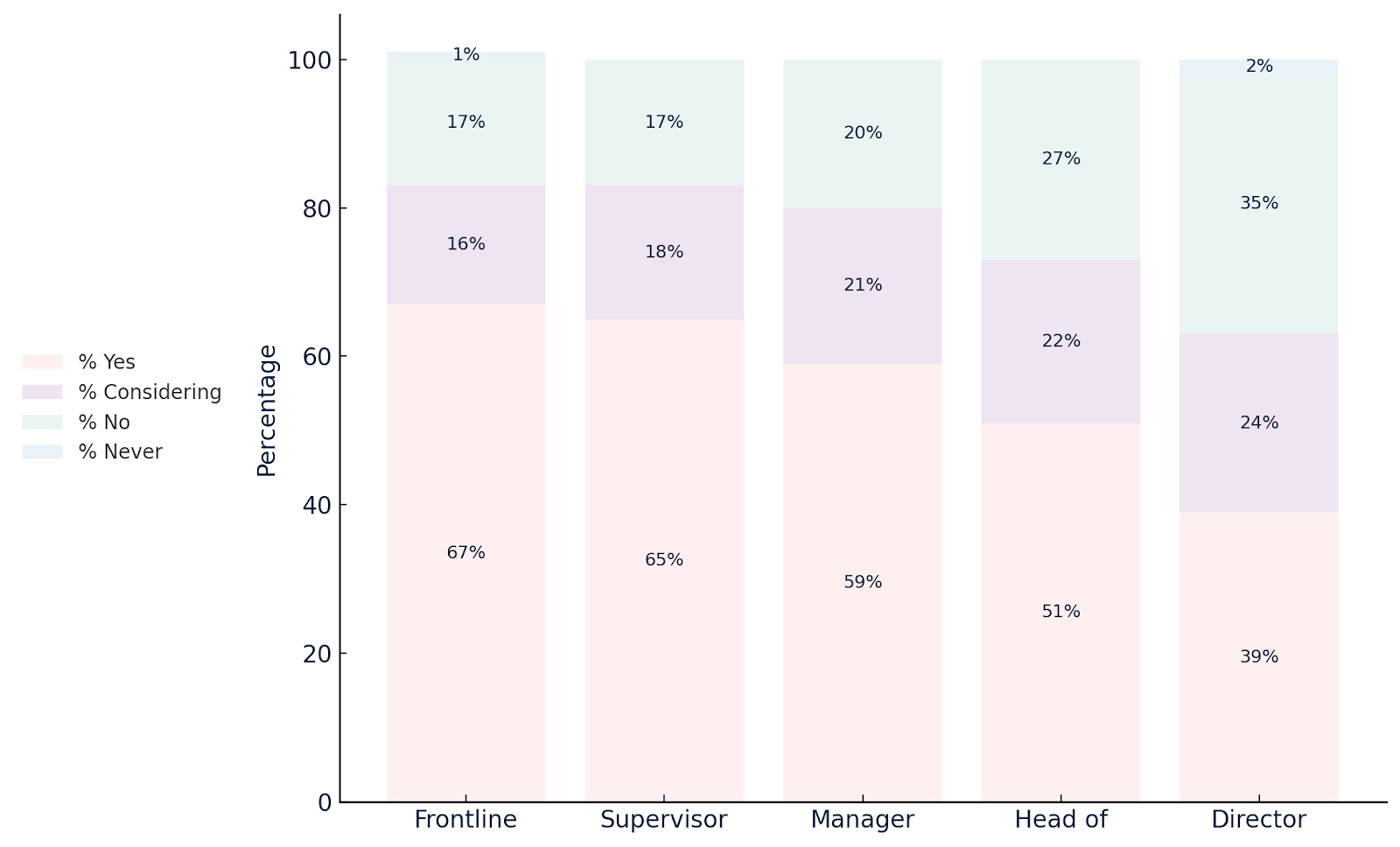
Responses to “Please indicate your organisation’s approach to including pay information in job postings” split by job seniority.
The study also found that salary disclosure rates vary widely by industry, with home services like repairs and in-home support topping the list, and mining and quarrying ranking lowest.
|
Industry |
Salary disclosure rate |
|
Home services |
98.5% |
|
Public sector |
90.4% |
|
Transport, distribution & storage |
88.4% |
|
Real estate |
87.4% |
|
Charity & non-profit |
86.2% |
|
Education |
83.5% |
|
Construction & engineering |
83.3% |
|
Energy & utilities |
81.8% |
|
Professional & business services |
80.7% |
|
Health & pharmaceutical |
80.5% |
|
Manufacturing |
79.1% |
|
Agriculture, forestry & fishing |
77.9% |
|
Legal |
74.7% |
|
Retail |
71.2% |
|
Finance & insurance |
70.8% |
|
Hospitality & leisure |
69.9% |
|
Technology & media |
65.7% |
|
Mining & quarrying |
64.6% |
The EU Pay Transparency Directive, which comes into force in June 2026, is also expected to influence UK pay practices, according to KMPG. Employers with operations in the EU will be required to disclose salaries to job applicants, refrain from asking candidates for their salary history, and report on their gender pay gap if they employ more than 100 people.
While there is currently no law requiring UK firms to disclose pay information publicly, those that resist pay transparency risk falling behind market expectations and failing to attract top talent. Gartner reported that 44% of candidates did not apply to a job that withheld the salary.
David Whifield, CEO and co-founder of HR Datahub, added: “Transparency levels the playing field so that everyone, regardless of gender, race or class, has an equal opportunity to earn a fair salary. It also gives candidates information to negotiate a fair and equitable salary based on what the role is worth to the company, rather than what they have the confidence to push for or what they were previously paid. Companies that don’t embrace pay transparency will fall behind. Leaders should be thinking about ‘when’ not ‘if’ to make the shift.”
HR Datahub’s salary benchmarking tool uses salary data from UK job boards to give companies insights into what they should be paying their employees to remain market competitive.
Add your comment

- Administration 3
- Building Design, Planning, Development 22
- Catering 11
- Construction 77
- Contracts, Projects, Bids 40
- Energy Management 142
- Engineering, Maintenance 665
- Estates, Property 46
- Events 9
- Facilities Management (main) 324
- Graduate, Apprenticeship & Intern 17
- Hard Services 69
- Health & Safety 1
- HVAC 284
- Management 9
- M&E 272
- Operations 142
- Procurement 21
- Sales & Marketing 11
- Soft Services 4
- Sustainability 7
- ICT, Technical 1
- Workplace 2